Since Christmas is drawing near, here's some food for thought for all of those planning to donate big money this holiday season. I'm not sure if I got the correct format in the citations part. Anyway, novice writer lang po ><

On Implications and Giving: A Discussion on
Over the last decade, the
world has bore witness to increasing public ire directed toward the wealthy. In
2011, this gradual build up of disenchantment culminated in the form of
protests in New York ,
famously known as the Occupy Wall Street Movement. Brandishing the slogan “We
are the 99%”, protesters complained about the growing inequality between the
wealthiest 1% of Americans, and the rest of the country. Demonstrations were
not just limited to the United States ,
as they quickly spread to Japan ,
China , Australia , Europe ,
and many other places.1
In the same year,
charitable donations in the US
rose to $298.42 billion. Of the total amount of donations, $217.79 billion came
from individual donors.2 Fundamentally, the same situation was seen
in Europe and Asia where foundations sprang up
by the hundreds, and funding multiplied. Contrary to what many think, the
wealthy are giving, and by statistics, giving a lot. But if philanthropy by
definition is “an active effort to promote human welfare”, then why does it
seem like the public is not at all “well”, despite the volume of charity?3
Are the wealthy not giving enough? Is it the manner of giving that is the
problem? Before answering these questions, it is essential to discuss why the
wealthy should engage in philanthropy in the first place.
The wealthy’s philanthropic
obligation has long been the subject of debate. The arguments for, and against
it are as varied as the number of human beliefs, situations and experiences.
But while arguments mostly revolve around donor-inherent reasons such as duty,
responsibility, and self-actualization, the following argument is anchored on
the actual implications of when the wealthy give, and when they do not. For
better illustration, it is essential to enumerate some of philanthropy’s
implications on education.
In 2011, charitable
donations to education in the US
amounted to $38.87 billion.4 This fund was able to sponsor
construction of more schools, develop existing ones, create scholarships, and
many more. When more people are educated, more are put in line for the chance
at a high paying job. Higher income for many would help reduce poverty and
improve individuals’ capacity to pay back existing loans, thereby reducing the
number of defaults and contributing to bank stability.
Additionally, better
education and opportunity lead to more capable participants in the market. New
talents, ideas and potential that additional participants bring will contribute
to the development of goods and services.5
However, what would have
been the outcome if the education sector did not receive such donations? What
if all the wealthy took back their contributions?
To start, all of the
positive implications brought about by big donations would completely overturn. Schools
would hobble on their own income or government subsidy alone, which entails
slower growth, and a very uncertain future. Additionally, many students,
especially the bright and talented ones (the usual recipients of scholarships)
would find it harder to get a good education, and society would be left out of
their potential to contribute. Development of human capital would be slower,
and institutions will lose out on prospective quality employees.
These examples suggest that
a strong cause to give back can be found in mutually beneficial or detrimental
implications for both donors and recipients. While the arguments for
donor-inherent reasons for giving vary from one person to another, the
implications of donations, or the lack of them, theoretically remain the same.
When giving stops, everyone is denied unnecessarily of its potential benefits.
The wealthy are not
necessarily alone in the obligation to give, as the implications will stand no
matter who gives back and who does not. However, given that the wealthiest 20%
of the world’s population own 82.8% of global income, the top earners are in
the most critical position to contribute to society’s welfare, including their
own, or conversely allow everyone to lose out.6


The present situation
however is a bit puzzling. Despite the huge amount of donations by the wealthy,
the public have yet to see significant changes. Many claim that philanthropy is
still unable to eliminate even the most basic problems of the poor. This leads
to the question, where is all the money going? According to Laskowski, part of
the answer can be found in the increasing financialization of foundations and
similar vehicles for giving.7
Financialization is a term
used for “the recent decline of manufacturing and the rise of banking and
investments.”8In the context of philanthropy, a foundation becomes
financialized when it functions like “a private investment company that uses
some of its excess cash flow for charitable purposes.”9 For example,
Donor Managed Investment(DMI) Accounts in the US provide a medium for donors to
invest donated money into other businesses. During the entire process, they
receive significant tax deductions and are able to maximize earnings from the
funds they have “donated.”10 Since the minimum annual payout for
foundations in the US
is just 5% of their assets (with some deductions), much of the money goes to
investments, rather than to their intended purpose. Many claim that conserving
or enlarging endowments are beneficial in the long run, and that they are
needed by the foundation to help others in the future. Whatever the
justification though, the result is just the same for the present. Foundations
end up creating a bottleneck for donated funds. Ultimately, when enough
foundations are managing their endowments in this manner, people will be less
likely to feel the benefits, as what is happening now.
Considering this situation,
what would be a good model of philanthropy that would make the public feel that
the wealthy are actually giving back?
In the 1920s, an American
named Julius Rosenwald introduced a novel concept of philanthropy. This concept
centered on the belief that perpetual endowments are actually the greatest
barriers to effective philanthropy. He greatly criticized perpetuities,
claiming that they only serve themselves rather than the very people they were
formed to help. Furthermore, he argued
that current generations should not struggle with current problems, while
perpetual foundations held out on funds that would have otherwise been used to
address these problems.11 His greatest argument however was made
through his own philanthropic actions.

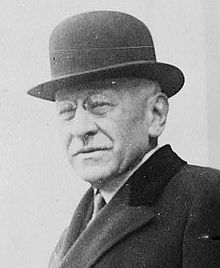
Image Credit: http://upload.wikimedia.org/wikipedia/commons/thumb/e/ec/Julius_Rosenwald_02.jpg/220px-Julius_Rosenwald_02.jpg
Rosenwald used his amassed
wealth as president of Sears Roebuck Company to establish the Rosenwald Fund.
This foundation primarily focused on “education, health and medical services,
fellowships for African-American professionals, and race relations.” Some of
these causes were already novel pursuits at the time, but what was really
unique about the Rosenwald Fund was its guidelines. Rosenwald directed the
foundation to “spend itself out of existence” within 25 years after his death.
Furthermore, Rosenwald introduced a new form of giving as part of his method of
helping people help themselves. He would donate $25,000 for the construction of
a school, if the recipient community would agree to shoulder the remaining
costs. To help willing communities raise funds, he would send organizers and
community advisers. Through this method, many African-American communities were
mobilized, and did not just serve as passive recipients.12

Image Credit: http://www.youneedaschoolhouse.com/wp-content/uploads/2012/12/Julius-and-Katie-Neely00014.jpg
Rosenwald was confident
that the society’s next generation would not necessarily run out of donors. And
by 1948(only 16 years after Rosenwald’s death, and 31 years from its
establishment), the Rosenwald Fund was depleted and officially stopped its
operations. In the short span of its existence, it was able to contribute to
the construction of 4,977 rural schools, give countless members of the
African-American community education and fellowships, and was also able to
fulfill its objectives in many other sectors.13
Today’s status quo bears several
similarities to the years when the Rosenwald fund was still active. The world
is in an economic crisis, there is still marked inequality, and many
foundations remain conservative of their payouts. However, the difference is
that perpetuation of endowments and financialization of foundations have
practically “combined” to render philanthropy even less effective.
Clearly, foundations today
need to reevaluate their method of giving if they indeed do want to make a
difference. Julius Rosenwald provided an excellent early example of responsible
philanthropy. He pointed that the focus of foundations should not be on
self-preservation, but on the actual causes that they were formed to address.
His methods that have benefited so many individuals can be summarized in 5
simple steps: (1) Assess the status quo, (2)
Find an urgent problem(s), (3) Formulate a
plan of giving that involves active recipient participation, (4) Give everything away intelligently within a
small timeframe, and (5) Evaluate and
recommend to fellow or future philanthropists. If charities would follow these
steps, then maybe change would be felt a lot sooner.
Looking
back, it has been more than half a century since the Rosenwald Fund officially
closed. Still, its legacy lives on through the thousands of “Rosenwald Schools”
and the countless African-Americans who now enjoy more prosperous lives. The
most important lesson Julius Rosenwald taught society is that progress should
never be uselessly delayed.

References
1. Thompson, D. (2011). Occupy the World: The
'99 Percent' Movement Goes Global. The Atlantic .
Retrieved from
http://www.theatlantic.com/business/archive/2011/10/occupy-the-world-the-99-percent-movement-goes-global/246757/
2. The 2012 Giving USA Annual Report on Philanthropy
for 2011: Results, Impact & the Future of Giving (2012). American
Association of Fundraising Counsel. As quoted in Charity Navigator (2012). American
Association of Fundraising Counsel. Retrieved from
http://www.charitynavigator.org/index.cfm?bay=content.view&cpid=42
3. “Philanthropy”. Merriam-Webster (2012).
Retrieved from http://www.merriam-webster.com/help/citing.htm. Date accessed:
November, 2012
4. The 2012 Giving USA Annual Report on Philanthropy
for 2011: Results, Impact & the Future of Giving (2012). Supra note 2.
5. Rosser, E. (2007). Obligations of
Privilege. NYU Review of Law & Social Change, American University
6. World Bank (2011), UNU-WIDER (2008) & Eurostat
(2011). As quoted in GLOBAL INEQUALITY: BEYOND THE BOTTOM BILLION: A Rapid
Review of Income Distribution in 141 Countries (2011).p.12. Unicef Social
and Economic Work Paper: Retrieved from http://www.unicef.org/socialpolicy/files/Global_Inequality.pdf
7. Laskowski, K. (2012). Philanthropy and Inequality:
What's the Relationship? Responsive Philanthropy, Winter
2011-2012. p.6
8. Laskowski, K. (2012). “Financialization”. Supra note
7. p.7
9. Laskowski, K. (2012). Supra note 7.
p.8
10. Ebelin, A. (2004). Stupid Tax Tricks. Forbes
Magazine. (2012) Retrieved from
http://www.forbes.com/forbes/2004/1101/086.html
11. Hoereth, J. (2007). Julius Rosenwald and the Rosenwald
Fund: A Case in Non-Perpetual Philanthropy. Loyola
University Chicago
12. Hoereth, J. (2007) Supra note 11. p. 158
13. Hoereth, J. (2007). Supra note 11. p.159


No comments:
Post a Comment